My Blog: Your guide to self-healing and wellbeing
Welcome to the Ria-jeannette Spiritual Coach blog. Here, we share insights, tips, and stories to help you on your journey to self-healing and personal growth. Discover complementary medicines, effective therapies, and practical techniques to empower your wellbeing.

Unlock your healing potential
Explore a wealth of knowledge on complementary medicines, therapies, and healing techniques. We aim to show you what is available to help yourself, from the gentle power of essential oils to the focused practice of hypnosis. Learn practical tips on Reiki, dowsing, crystals, and Emotional Freedom Technique (EFT) to support your path to wellness.
Embrace spiritual self-healing
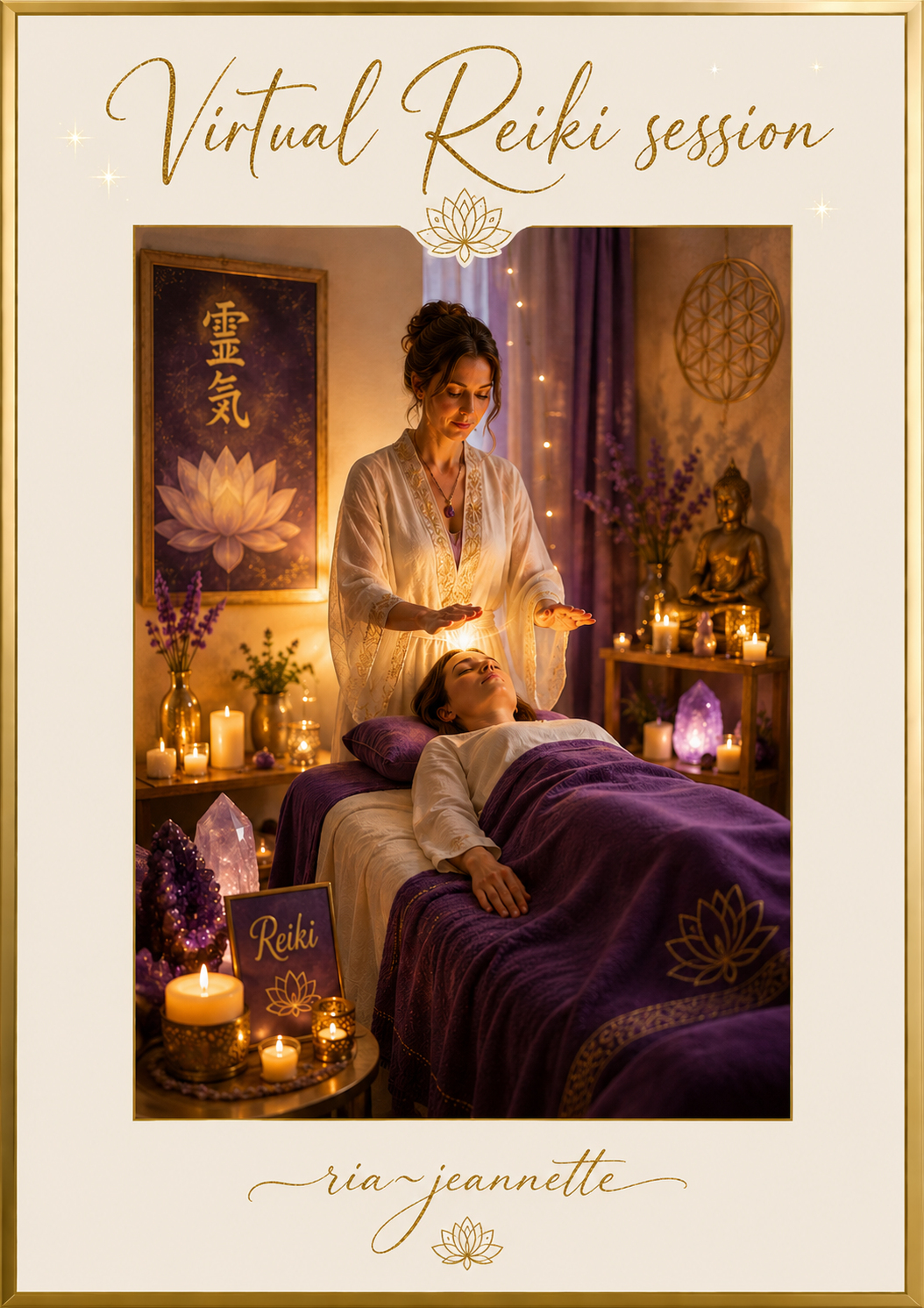
Delve into topics that nurture your spirit and mind. Understand how Reiki invites you into a warm and comfortable space, allowing you to relax and give yourself the time you deserve. Discover the benefits of mindfulness, starting with simple yet impactful techniques crucial for your wellbeing. We're excited to explore all the options you can work with, including the profound effects of EFT.

Join the conversation for wellness
We hope this blog empowers you on your self-healing journey. Your insights and experiences are valuable, and we encourage sensible comments and open discussions on our posts. Let's grow and heal together as a community. For any direct enquiries, please contact us at: ria.jeannette@aol.com

TELOMERES WHAT ARE THEY?

The Secret to Aging Slower Isn’t What You Think
How stress, mindset, and daily habits shape your cells—and your future
Telomeres Explained: The Tiny DNA Caps Linked to Ageing and Health
Ever noticed the little plastic tips on the ends of your shoelaces? Without them, your laces unravel into a tangled mess faster than a cheap charger cable.
Well, your body has its own version of shoelace tips — and they’re called telomeres.
Scientists believe these tiny protective caps may play a major role in ageing, health, and how well our bodies cope with stress. Sounds dramatic for something microscopic, but welcome to modern biology.
What Are Telomeres?
Telomeres are protective caps found at the ends of your chromosomes — the structures that carry your DNA.
Their job is simple: they stop your DNA from becoming damaged when cells divide.
Every time your cells reproduce, telomeres get a little shorter. Eventually, they become too short to do their job properly, and cells either slow down, stop working efficiently, or retire completely like an exhausted office worker counting down to Friday afternoon.
This shortening process is now linked to ageing and age-related diseases.
Why Are Scientists So Interested in Telomeres?
For years, researchers thought telomeres might act like a biological countdown clock.
Long telomeres = healthier, younger cells.
Short telomeres = older, worn-out cells.
But newer research shows things are more complicated.
Scientists now believe telomeres are just one part of a much bigger ageing puzzle involving inflammation, stress, sleep, exercise, and overall lifestyle.
As one longevity researcher recently put it:
“Telomeres were once the rock stars of anti-ageing science. Now they’re more like part of the band.”
What Causes Telomeres to Shorten Faster?
Research suggests several factors may speed up telomere shortening, including:
• Chronic stress
• Poor sleep
• Smoking
• Lack of exercise
• Ultra-processed foods
• Chronic inflammation
• Excess alcohol
• Long-term illness
Which explains why your body sometimes reacts to stress like it’s preparing for battle… even when you’re just answering emails.
Can You Protect Your Telomeres?
Possibly — and the advice is surprisingly familiar.
Studies suggest healthy lifestyle habits may help support telomere health, including:
• Regular exercise
• Quality sleep
• Managing stress
• Eating nutrient-rich foods
• Staying socially connected
• Avoiding smoking
Sadly, scientists have not confirmed that wine, pizza, and binge-watching crime documentaries count as a longevity programme.
The Latest Telomere Research
One of the biggest shifts in recent research is the idea of biological age versus chronological age.
Chronological age is the number on your birthday cake.
Biological age is how old your body actually behaves.
That’s why some people seem energetic at 70 while others start making mysterious knee noises at 35.
Scientists are also studying an enzyme called telomerase, which may help rebuild telomeres. However, researchers are cautious because cancer cells can also use telomerase to grow.
So while telomere science is exciting, we are definitely not at the “live forever” stage just yet.
Should You Get a Telomere Test?
Telomere testing has become popular in the wellness and anti-ageing world.
Some experts think these tests can provide useful insights into cellular ageing. Others believe the science is still developing and results should be taken with caution.
Translation: interesting information, but probably not something to panic about during breakfast.
Final Thoughts
Telomeres may be tiny, but they’re giving scientists big clues about ageing, health, and longevity.
The latest research suggests there’s no miracle anti-ageing shortcut hiding in a fancy supplement bottle.
Instead, the boring basics still matter most: sleep well, move your body, eat reasonably well, and try not to spend your life stressed over things you can’t control.
Your telomeres — and your shoelaces — will probably thank you for it.
Sources & Further Reading
- Blackburn EH. Switching and signaling at the telomere. Cell. 2001.
- Epel ES et al. Accelerated telomere shortening in response to life stress. PNAS. 2004.
- Shammas MA. Telomeres, lifestyle, cancer, and aging. Current Opinion in Clinical Nutrition & Metabolic Care. 2011.
- Harvard Medical School – Understanding Telomeres and Aging.
- Mayo Clinic – Biological Ageing and Telomere Research.
Nature Reviews Molecular Cell Biology – Telomeres and Ageing (recent review articles).
The Ancient Energy Breathing Points known as
The Dan-tian.
The Dan-tian: Understanding the Energy Centres
The Dan-tian, often referred to as the "elixir field," is a significant concept in traditional Chinese medicine and martial arts. It is considered the body's primary energy centre, where vital energy, or "Qi," is cultivated and stored. There are three main Dan-tian locations within the body: the lower, middle, and upper Dan-tian.
The lower Dan-tian, located just below the navel, is the most crucial as it is thought to be the source of physical vitality and strength. Practitioners of Tai Chi, Qigong, and other martial arts focus on this area to enhance their energy levels and improve overall health.
The middle Dan-tian, situated in the chest, is associated with emotional balance and the heart, while the upper Dan-tian, located in the forehead, relates to spiritual awareness and mental clarity.
Cultivating the Dan-tian involves various breathing techniques, meditation, and physical exercises that promote the flow of Qi throughout the body. By nurturing this energy centre, individuals can achieve greater harmony, vitality, and well-being.
What Does “Breath Dropping into the Dan-tian” mean? the breath does not literally enter the abdomen. Instead, the diaphragm moves downward, the belly expands naturally, and attention settles lower in the body. This often creates feelings of calm, warmth, heaviness, or steadiness.
What Is Meant by “Storing Qi”?Traditional teachings describe the lower dan-tian as a reservoir where qi (life energy) gathers. In modern terms, this can be understood as conserving energy by reducing tension, calming the nervous system, improving posture, and breathing more efficiently.
How Do You Allow Energy to Collect Naturally? Relax the shoulders, jaw, and belly. Breathe slowly and softly into the lower abdomen. Do not force or imagine dramatic energy movements. Place gentle attention a few inches below the navel. Allow the breath to become calm and quiet. Practice regularly for 5–10 minutes daily.Traditional instruction often says: 'Where attention rests, qi gathers.' The emphasis is usually on relaxation and steadiness rather than force.
WHERE ARE THE DAN-TIAN ENERGY POINTS?
further reading:Source: Fabrizio Pregadio, “Cinnabar Fields (Dantian),” Golden Elixir Press. Available at GoldenElixir.com

EMOTIONAL FREEDOM TECHNIQUE (EFT)
Emotional Freedom Tapping Technique,
Emotional Freedom Technique (EFT), often referred to as "tapping," is a form of psychological acupressure that aims to reduce stress and alleviate negative emotions. This technique combines elements of cognitive therapy and exposure therapy with acupressure in the form of fingertip tapping on specific meridian points on the body.
The Basics of Emotional Freedom Tapping
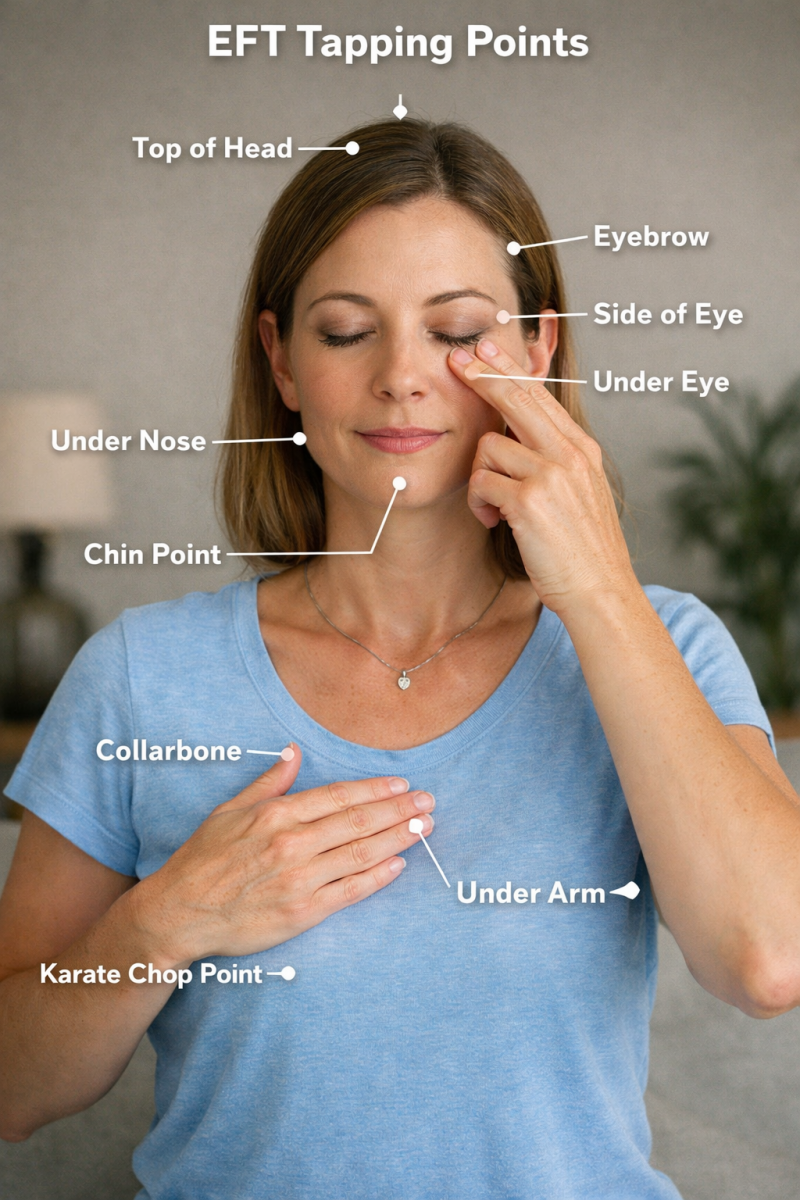
EFT involves tapping on nine specific points on the body while focusing on a specific issue or emotion. These points are primarily located on the head and face, as well as the upper body. The sequence of tapping begins with the "karate chop" point on the hand and proceeds through the following points: The ‘karate chop acupressure point acts as a psychological reversal (on the side of the hand), here you would say:
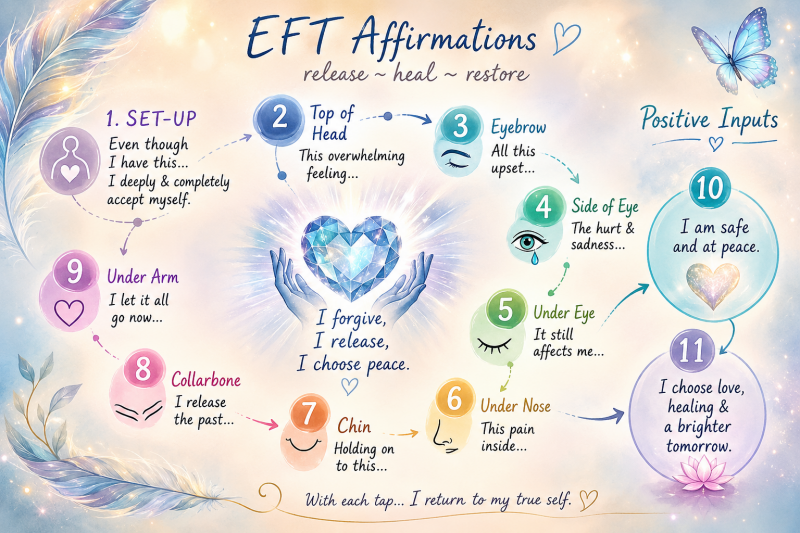
Affirm: “Even though I have......(this problem of hurt, pain, anxiety etc) I still accept myself”
- Top of the Head
- Eyebrow
- Side of the Eye
- Under the Eye
- Under the Nose
- Chin
- Collarbone
- Under the Arm
- Karate Chop (side of the hand)
Steps to Perform EFT
- Identify the Issue
Begin by identifying the emotional or physical issue you wish to address. This could be anything from anxiety and stress to physical pain or limiting beliefs.
- Rate the Intensity
On a scale from 0 to 10, rate the intensity of the discomfort you are experiencing. This will help you gauge your progress as you tap.
- Set Up a Statement
Create a setup statement that acknowledges the problem and affirms self-acceptance. An example might be: “Even though I feel anxious about my exam, I deeply and completely accept myself.”
- Tap on the Points
Using the fingertips of your index and middle fingers, tap about 5-7 times on each point. As you tap, repeat a reminder phrase that encapsulates the issue, such as “this anxiety.”
- Reassess the Intensity
After completing the tapping sequence, take a deep breath and reassess the intensity of your emotion or discomfort. Repeat the process until the intensity decreases to a level you’re comfortable with. So, the idea is you move from 10 ...high level of discomfort down to zero, being cleared or close to it.
Take three breaths and move the eyes, open, close, right, then left. This signifies to the brain that change is taking place. At this point, you may wish to start tapping with the opposite hand, just the acupressure points, to include positive affirmations such as “I now recognise and accept that these positive changes taking place are for my benefit and well-being”, followed by any positive affirmation you wish to use.
Benefits of EFT
EFT is known for its potential to provide relief from various emotional and physical ailments. Some of the benefits include:
- Stress Reduction: By tapping on specific points, EFT can help lower cortisol levels and reduce stress.
- Improved Emotional Health: EFT can aid in releasing negative emotions and fostering a positive mindset.
- Pain Relief: Many users report a decrease in physical pain after tapping sessions.
- Enhanced Performance: Athletes and professionals use EFT to improve focus and performance by reducing anxiety and self-doubt.
Scientific Support and Criticisms
While EFT has a growing base of anecdotal support, scientific research is still evolving. Some studies suggest that EFT may be effective for reducing symptoms of anxiety and depression. However, critics argue that more rigorous studies are needed to substantiate these claims and understand the mechanisms behind EFT.
Why does EFT work for trauma-related incidents? How does the Amygdala part of the brain have an effect?
The Role of the Amygdala in EFT
The amygdala, a small almond-shaped cluster of nuclei located deep within the brain's temporal lobe, plays a crucial role in processing emotions and is particularly important in the body's response to stress and trauma. When a person experiences a traumatic event, the amygdala is activated, triggering the "fight or flight" response, which can lead to heightened anxiety and stress. Emotional Freedom Tapping is believed to work by calming this response. The gentle tapping on meridian points is thought to send soothing signals to the amygdala, helping to reduce the intensity of the emotional and physical response to stress. By doing so, EFT may facilitate emotional regulation, allowing individuals to process traumatic memories without becoming overwhelmed by their emotions. This calming effect on the amygdala can contribute to the overall effectiveness of EFT in dealing with trauma-related incidents, providing individuals with a sense of relief and empowerment over their emotional well-being.
Conclusion
Emotional Freedom Tapping is a versatile and user-friendly technique that can be practised anywhere. While it may not be a substitute for professional mental health treatment, it serves as a valuable tool for self-care and emotional management. As with any therapeutic practice, individuals should approach EFT with an open mind and consult with a healthcare professional for personalized guidance.
A brief article of EFT by Ria~jeannette
source: NLP & Kinesiology, Bandler & Grinder.
Gary Craig, EFT. Founder (RIP) Thank you for sharing your techniques on such a wide scale, for all to benefit.
Gallo Fred. P, 2007, Energy Tapping for Trauma. www. energypsych.com